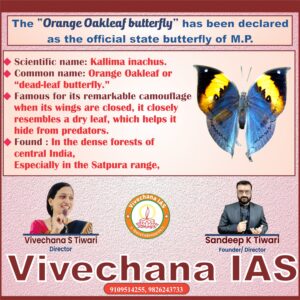
Orange Oakleaf Butterfly Declared as State Butterfly of Madhya Pradesh
Introduction
Madhya Pradesh is set to declare the Orange Oakleaf (Kallima inachus) as its state butterfly, marking a significant milestone in the state’s conservation efforts and biodiversity recognition. MP will become the first state in central India (not whole india) to notify a state butterfly, joining a select group of Indian states that have designated official state butterflies.
The Orange Oakleaf: Nature’s Master of Disguise
Scientific Classification and Names
Kallima inachus, the orange oakleaf, Indian oakleaf or dead leaf, is a nymphalid butterfly found in Tropical Asia from India to Japan. This remarkable butterfly belongs to the family Nymphalidae and has earned various common names due to its extraordinary appearance and behavior.
The Art of Camouflage
With wings closed, it closely resembles a dry leaf with dark veins and is a commonly cited example of camouflage. This spectacular mimicry is one of nature’s most impressive survival strategies.
Closed Wing Appearance
When the wings are closed, only the cryptic underside markings are visible, which consists of irregular patterns and striations in many shades of biscuit, buff, browns, yellow, and black. The veins are darkened and resemble the veins of a leaf. The resemblance to a dried leaf, a masquerade, is extremely realistic and gives the genus its common names, the oakleaf or dead leaf.
Open Wing Display
When the wings are open, the forewing exhibits a black apex, an orange discal band and a deep blue base. There are two white oculi, one along the margin of the apical black band, and the other bordering the orange and deep blue areas. This striking contrast between the cryptic underside and vibrant upper wings makes the Orange Oakleaf one of nature’s most dramatic transformations.
Physical Characteristics
The butterfly has an impressive size, with a wingspan ranging between 85-110 mm (3.3-4.3 in), supporting its fast and erratic flight pattern. The butterfly wings are shaped like a leaf when in the closed position, adding to the effectiveness of its camouflage.
Survival Strategies and Behavior
Anti-Predator Tactics
Much pursued by birds, when in danger the orange oakleaf flies erratically, soon dropping down into the foliage and occupying a stationary pose with wings closed, so that the birds are very often quite unable to find them. In such a pose, the butterfly resembles a dried leaf and is perfectly camouflaged.
The flight of the Orange Oakleaf is both fast and erratic, an adaptation that likely helps avoid predators through unpredictability.
Natural Enemies
The natural enemies of the orange oakleaf include birds, ants, spiders, wasps (including Trichogramma species), and some bacteria. Despite these numerous threats, the butterfly’s remarkable camouflage and erratic flight patterns help ensure its survival.
Geographic Distribution
Overall Range
The orange oakleaf is found in India, Nepal, Bhutan, Bangladesh, and Myanmar, down to Tenasserim Hills. In Southeast Asia it occurs in southern China, Thailand, Laos, Taiwan, and Vietnam. It has been also recorded from Pakistan in 2000.
Distribution in India
In India, the butterfly flies in the Himalayas at low elevations, from Jammu and Kashmir, through Garhwal and Kumaon to West Bengal, Sikkim, Arunachal Pradesh, and other states of the northeast.
Presence in Madhya Pradesh
It is also found in central and peninsular India; it flies in Madhya Pradesh, Jharkhand, Chhattisgarh, Orissa and Andhra Pradesh, specifically along the central Indian highlands to Pachmarhi and Amarkantak, the Western Ghats south to Bhimashankar, and in the Eastern Ghats north of the river Godavari.
In Madhya Pradesh specifically, it is not common and largely restricted to Satpura National Park, not all tiger reserves, indicating its selective habitat preferences within the state.
Life Cycle and Breeding
Flight Period
In the Himalayas, the butterfly is multivoltine and flies from April to October. Kehimkar (2009) records the butterfly on the wing in India from April to December.
Development Stages
In Chongqing one generation has been recorded as taking about 50 days from egg to imago. The egg period lasted about 6 days, the larval period 36 days, and involved 5 to 6 instars (usually 5) and with the pupation lasting about 10 days.
Environmental Requirements
The caterpillars bred successfully at temperatures of 22 to 31.5 °C (71.6 to 88.7 °F) and relative humidity of 48 to 98%. These specific requirements indicate the butterfly’s adaptability to various climatic conditions found across its range, including Madhya Pradesh.
Temperature Effects on Development
Investigations in an artificial climate chamber reveal that photoperiod and temperature play a role in the larval development and survival rate of the larvae of K. inachus. As temperature increased from 20 °C to 25 °C and 30 °C, the developmental periods of larvae reduced under the same photoperiod to 31.7 to 36.0 days, 26.37 to 27.4 days and 21.0 to 21.5 days, respectively.
Conservation Status and Research
The status of the butterfly in India is “not rare”, while in China, the butterfly is considered “rare”. This difference in conservation status highlights the importance of India’s role in protecting this species.
The butterfly is considered to be rare in China and consequently much research in its captive breeding has been done. In controlled environments, a female can lay an average of 280 eggs, indicating the species’ potential for rapid population growth under optimal conditions.
Ecological Significance
Habitat Preferences
The Orange Oakleaf shows distinct habitat preferences. The species prefers moist forested habitats, not arid western India. The orange oakleaf is encountered up to an altitude of 1,800 metres (5,900 ft) in the hills; though Wynter-Blyth records it as being encountered up to 8,000 feet (2,400 m).
Feeding Behavior
Unlike many butterflies, the Orange Oakleaf is not drawn to flowers. Instead, it is attracted to rotting fruit and tree sap.
State Butterflies in India: A Growing Movement
Seven Indian States have declared State Butterflies in India. These include:
Significance for Madhya Pradesh
The selection of the Orange Oakleaf as Madhya Pradesh’s state butterfly holds multiple layers of significance:
Biodiversity Recognition
Madhya Pradesh is home to diverse butterfly fauna. A survey conducted to record the diversity and abundance of butterfly fauna on the campus of Barkatullah University, Bhopal, Madhya Pradesh, India, from March 2024 to July 2024 recorded a total of thirty-six species of butterflies belonging to four families. Nymphalidae comprised the highest number of species, followed by Pieridae, Papilionidae, and Lycaenidae, respectively.
Conservation Importance
The designation of a state butterfly serves as a powerful tool for conservation awareness. It brings attention to the need for protecting forest habitats, particularly the moist forested areas that the Orange Oakleaf prefers. This is especially relevant for areas like Satpura National Park, where the species is primarily found in the state.
Educational Value
The Orange Oakleaf’s remarkable camouflage makes it an excellent educational tool for demonstrating evolution, adaptation, and ecological relationships. Its dramatic transformation from vibrant upper wings to leaf-like underside provides a tangible example of nature’s ingenuity that can inspire students and nature enthusiasts.
Cultural and Tourism Potential
State symbols often become focal points for eco-tourism and nature education programs. The Orange Oakleaf, with its fascinating behavior and appearance, could attract butterfly watchers and nature photographers to Madhya Pradesh’s forests, potentially boosting eco-tourism while promoting conservation.
National Context
India recently elected a National Butterfly, with about 1500 species of butterflies to choose from. Some Indian states have even named their own State butterflies, but this is the first time a National butterfly was named. With over 60,000 votes, it was a landslide victory for the Orange Oakleaf butterfly (Kallima Inachus) as the people’s choice, though this appears to have been an unofficial poll rather than an official government designation.
Future Implications
The declaration of the Orange Oakleaf as Madhya Pradesh’s state butterfly represents more than symbolic recognition. It signals:
Conclusion
The designation of the Orange Oakleaf (Kallima inachus) as Madhya Pradesh’s state butterfly represents a significant step in recognizing and protecting the state’s rich biodiversity. This master of disguise, with its extraordinary ability to transform from a vibrant, colorful butterfly to a perfect imitation of a dead leaf, embodies the wonder and complexity of nature.
As the first state in central India to designate an official state butterfly, Madhya Pradesh sets an example for other states in the region. The Orange Oakleaf’s presence in the state’s forests, particularly in areas like Satpura National Park, highlights the importance of preserving these crucial habitats.
Through this designation, Madhya Pradesh not only celebrates its natural heritage but also commits to the conservation of this remarkable species and its forest ecosystem. The Orange Oakleaf butterfly, with its dramatic survival strategies and ecological significance, serves as an ambassador for the state’s biodiversity and a symbol of nature’s endless capacity for innovation and adaptation.


Stay ahead in a rapidly world. Subscribe to Prysm Insights,our monthly look at the critical issues facing global business.

