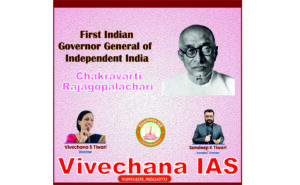
Born: 10 December 1878, Thorapalli, Salem district (now Krishnagiri district), Tamil Nadu.
Family: He was born into a devout Tamil Brahmin family. His father, Chakravarti Venkataryan, was a munsiff (judge) at Thorapalli.
Education: Rajagopalachari studied at Central College, Bangalore, and later pursued law at Presidency College, Madras. He established a successful legal practice at Salem but soon became active in public affairs.
Initially a member of the Indian National Congress, he was drawn into the national movement after being inspired by Mahatma Gandhi.
He gave up his legal practice to join the freedom struggle.
Non-Cooperation Movement (1920): Actively participated, encouraging Indians to boycott British goods and institutions.
Vaikom Satyagraha (1924): Supported the movement for temple entry rights for lower castes in Kerala.
Civil Disobedience Movement (1930):
He led the famous Vedaranyam Salt March in Tamil Nadu, similar to Gandhi’s Dandi March in Gujarat.
Imprisonments: Like most Congress leaders, he was repeatedly imprisoned by the British for his nationalist activities.
Chief Minister of Madras Presidency (1937–1939):
Implemented prohibition of alcohol.
Introduced reforms in education, especially compulsory elementary education.
Governor of West Bengal (1947–1948): After independence, he was appointed the first Indian Governor of West Bengal.
Governor-General of India (1948–1950):
After Lord Mountbatten left, Rajagopalachari became the last Governor-General of India and the only Indian to hold this post.
Home Minister (1951): Served under Prime Minister Jawaharlal Nehru.
Chief Minister of Madras (1952–1954): Introduced the controversial Hereditary Education Policy (Kula Kalvi Thittam), which faced criticism and was eventually scrapped.
Disillusioned with the direction of the Congress under Nehru, Rajagopalachari founded the Swatantra Party in 1959.
The party opposed socialism and state control, advocating free enterprise, individual liberty, and minimal government interference.
The Swatantra Party gained significant popularity, especially among zamindars, businessmen, and conservative sections, and became the largest opposition party in the 1960s.
Rajagopalachari was also a writer, translator, and thinker.
He wrote extensively in Tamil and English.
His most famous works include:
Retellings of the Mahabharata and Ramayana (in simple Tamil and English, widely read even today).
Translations of Indian classics like the Bhagavad Gita.
Essays on politics, philosophy, and culture.
He was respected as a moral and intellectual authority in Indian politics.
Married Alamelu Mangamma, who passed away early, leaving him with five children.
He was known for his simple lifestyle, sharp intellect, and integrity.
Gandhi often called him his “conscience keeper.”
C. Rajagopalachari passed away on 25 December 1972 in Madras (now Chennai) at the age of 94.
His death marked the end of an era — he was the last surviving major leader of India’s freedom struggle.
Remembered as:
A freedom fighter and close associate of Gandhi.
The last Governor-General of India.
A statesman who valued democracy, individual liberty, and ethics in politics.
A great writer and cultural interpreter of Indian epics.
Though sometimes criticized for being conservative, his foresight on economic liberalization and governance is seen as ahead of its time.


Stay ahead in a rapidly world. Subscribe to Prysm Insights,our monthly look at the critical issues facing global business.
